
NARROWER HANDLEBARS ON ROAD BIKES, PART 1
INTRODUCTION
Going narrower is all the rage right now, except for Mathieu Van Der Poel who, in a recent interview, explained he is keeping his usual handlebar width as it helps him push more power. Considering the amount of power this champion can push, it would be hard to contradict him. The trend went so far that for 2026, the UCI had to create new rules to ensure handlebars would not go narrower than 40 cm at the drops (outside-to-outside dimensions) and that it would not be possible to angle the shifters in a "crazy" way, with a limit of 28 cm internal dimension between both shifters.
While narrowing road handlebars seems obvious on paper, there was no simple way to validate the gains being promoted without doing wind tunnel or field testing. Neither of these are easy to organize, as repeatability is difficult to ensure and the process is time-consuming with integrated cable housings and varied setups.
With AiRO, we can finally test as many handlebars as we want on as many body shapes as we want, with the exact rider positions we desire.
METHODOLOGY
In order to test aerodynamic theories, we had to create our own team: the AiRO Team. We "hired" four women and four men with vastly different physical characteristics to ensure our results aren't just anomalies of a single body shape. This diverse group allows us to see how wind interacts with different shoulder widths, torso lengths, and muscular builds.
Meet the AiRO Team (Our 8 Permanent Members):
AiROn: 176 cm, 67 kg (Men’s GC Leader). Lean and balanced.
ANNA: 169 cm, 58 kg (Women’s GC Leader). Compact and efficient.
CHRIS: 172 cm, 60 kg (Men’s Climber). Slender and light.
CLAIRE: 180 cm, 70 kg (Women’s Sprinter). Tall and powerful.
JOE: 190 cm, 85 kg (Men’s Sprinter). Broad-shouldered and muscular.
LAUREN: 165 cm, 63 kg (Women’s Allrounder). Sturdy "Rouleur" build.
SARAH: 158 cm, 47 kg (Women’s Climber). Extremely petite.
TOM: 182 cm, 75 kg (Men’s Allrounder). Standard high-performance profile.
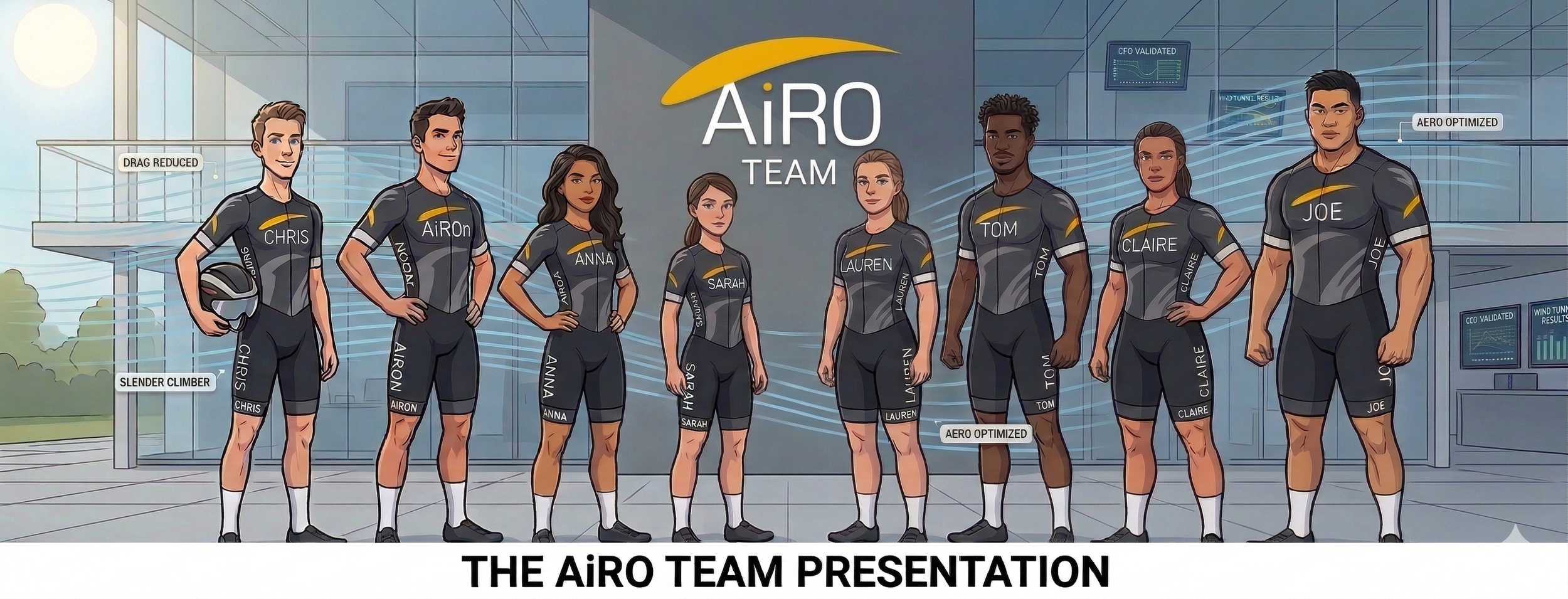
For this Part 1 study, we analyzed 32 configurations (8 riders x 4 handlebar widths : 42, 40, 38 and 36 cm. All simulations utilized a Mid-Tier Aero Road bike and a Specialized Evade 3 helmet.
We operated under a key assumption: hands and elbows remained aligned as the width narrowed. While some cyclists may struggle to adapt—resulting in "flared elbows"—we established this alignment as our baseline for Part 1 to isolate the aerodynamic effect of the handlebar itself and the subsequent narrowing of the rider's frontal silhouette.
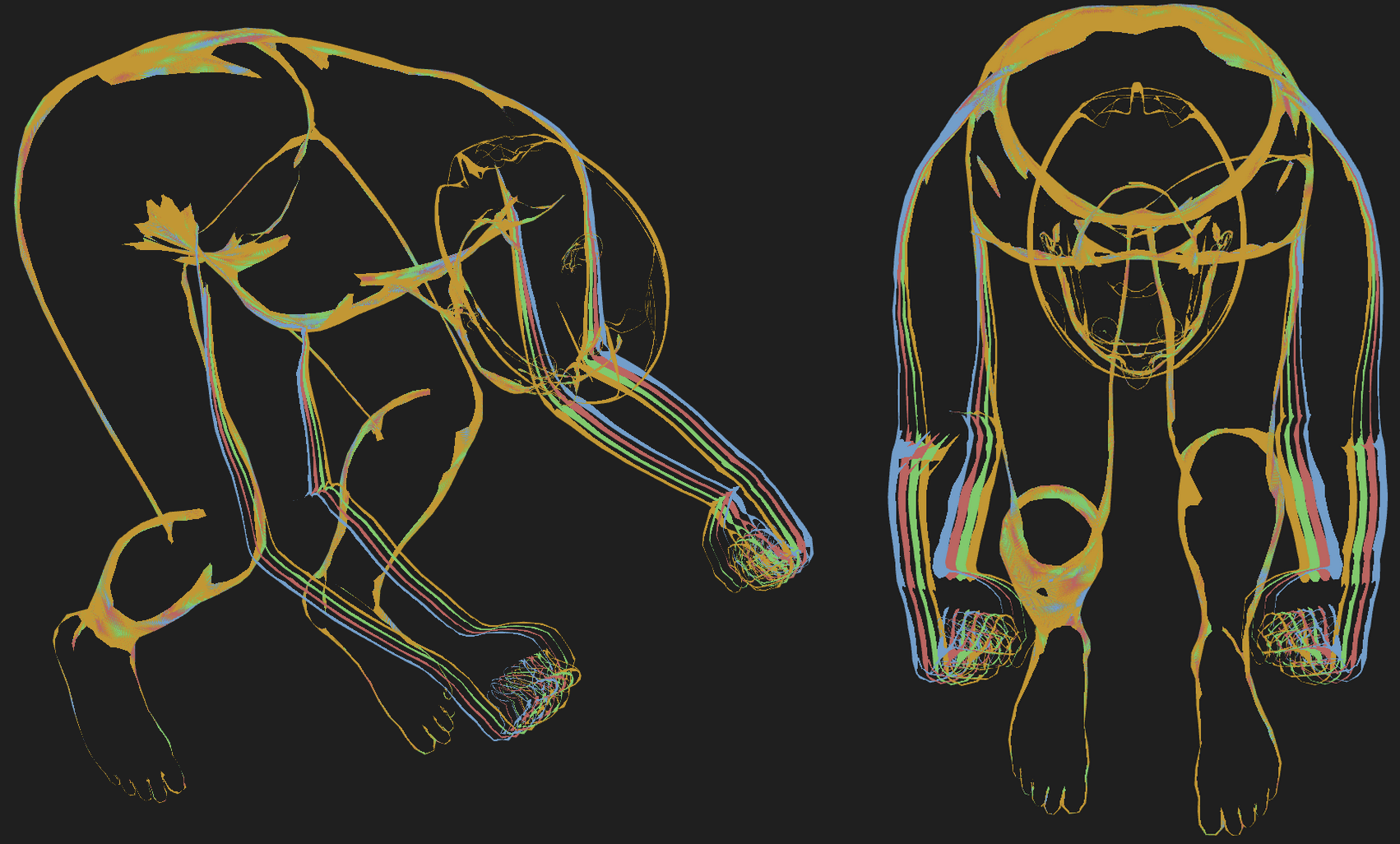
HANDLEBAR WIDTH CHANGE - IMPACT ON THE CYCLIST, EVERYTHING ELSE BEING EQUAL
DATA ANALYSIS: THE RESULTS
Aerodynamics is often described as the "invisible science," where marginal gains are hidden behind the complex interactions of air pressure and turbulent wakes. To unveil these mysteries, we processed our 32 configurations through the AiRO simulation engine, generating a high-fidelity map of the aerodynamic fingerprint for each rider profile.
The primary metric of our evaluation is CdA (the Coefficient of Drag multiplied by Frontal Area)—the ultimate indicator of how much wind resistance a rider must overcome. While the industry "rule of thumb" suggests that narrowing the handlebar always leads to a linear reduction in drag, our data reveals a far more nuanced reality. By stripping away subjective "feel" and replacing it with precise CFD metrics, we can see exactly where the air flows smoothly and where the equipment begins to clash with the athlete's anatomy.
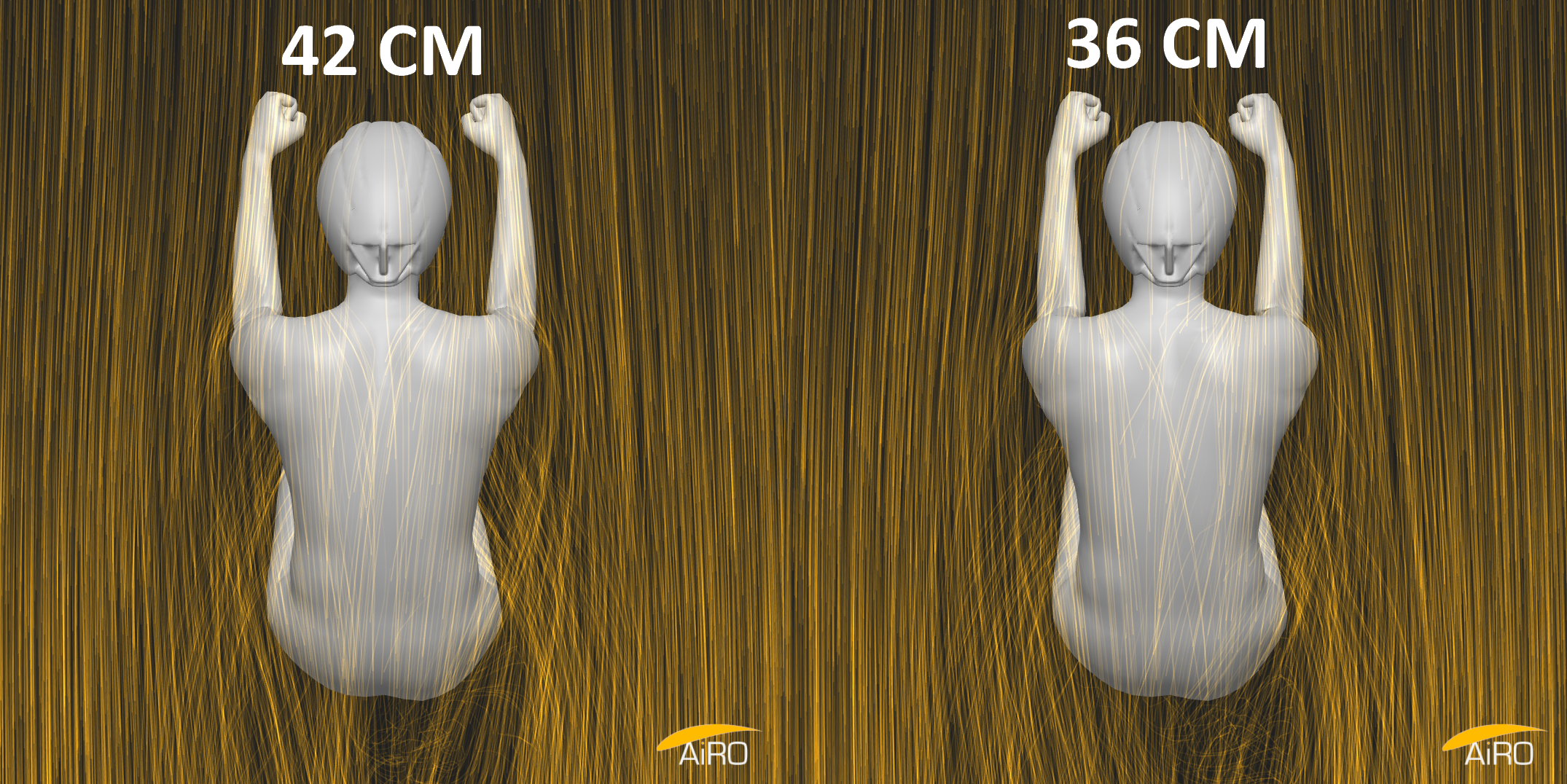
CFD TOP VIEW : ONE CYCLIST, MAXIMUM AND MINIMUM WIDTH TESTS
Below, we break down the performance matrix. For some of our riders, the digital wind tunnel confirmed the "narrower is faster" hypothesis; for others, the results uncovered aerodynamic "clashes" that would have remained invisible without high-level simulation.
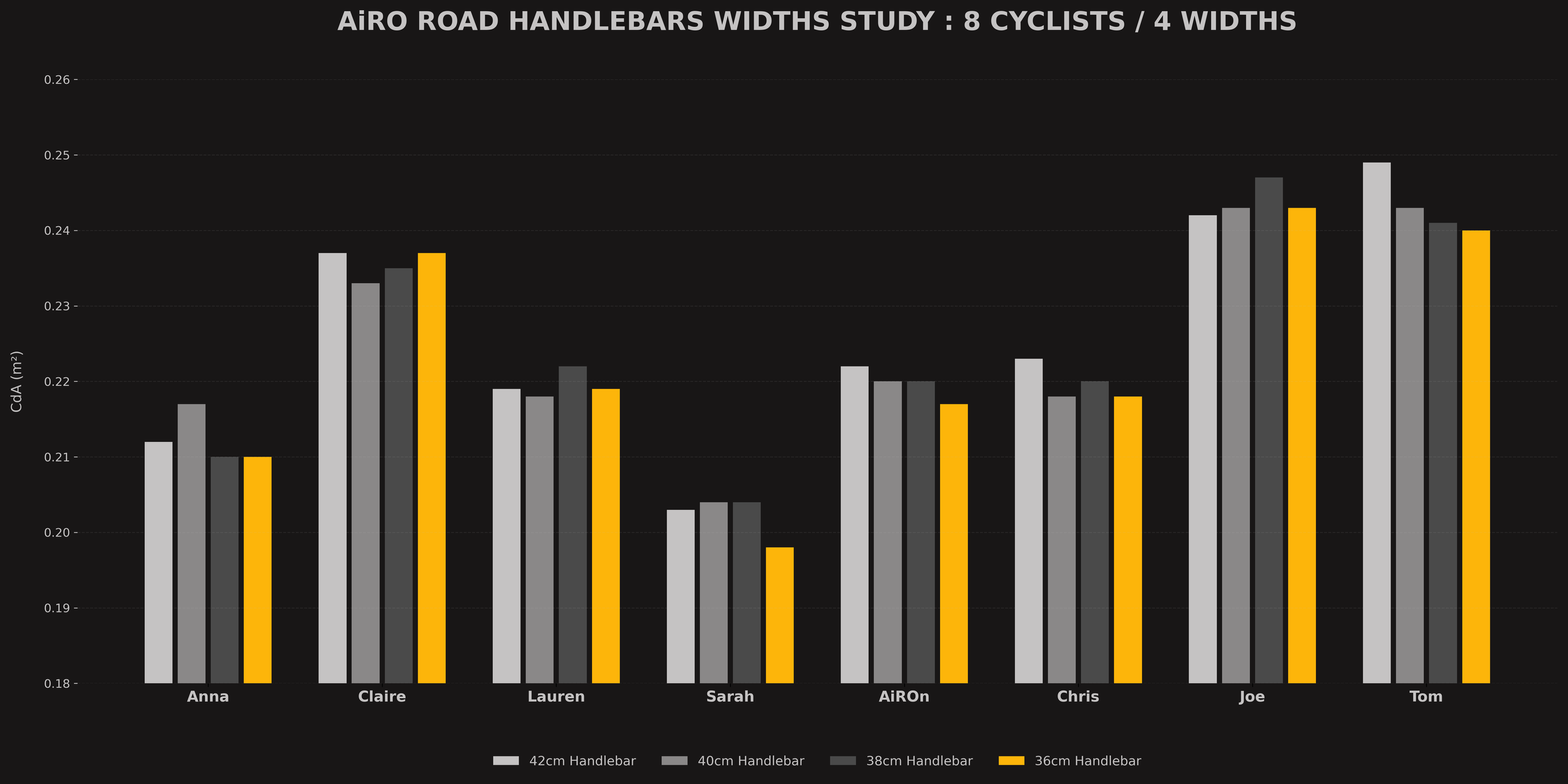
COMPARING HANDLEBARS RANGING FROM 42 CM TO 36 CM ON 8 DIFFERENT CYCLISTS
When we look at the results, three distinct stories emerge:
The Silhouette Advantage: For riders like Tom, Sarah and AiROn, narrowing the bars effectively pulls the arms inside the "wind shadow" of the torso. This results in a near-linear reduction in CdA, leading to the massive 8 Watt savings Tom observed at 40km/h.
The Interaction Clashes: In the cases of Joe and Anna, we see "spikes" in drag at specific widths (38 cm for Joe and 40 cm for Anna). This occurs when the arms are positioned in a way that disrupts the airflow over the hips or legs, creating localized turbulence that outweighs the benefit of a narrower frontal area.
Sprinter bodies: Both sprinters in our Team (Claire and Joe) show little to no benefit when going to narrower handlebars, indicating that if they can achieve a higher sprinting power with a wider stance, the aerodynamic trade-off is virtually non-existent.
When we analyze Joe, our largest rider (190 cm}, 85 kg), his CdA actually peaked at 0.247 when using 38 cm bars, which is a significant penalty compared to his 0.242 baseline at 42 cm. Similarly, Claire (180 cm, 70 kg) ended her test at 36 cm with a CdA of 0.237, exactly where she started at 42 cm.
From an engineering perspective, this suggests a "saturation point" for wider-shouldered, muscular athletes. As the hands move inward, the muscular volume of the shoulders and chest is forced to "bunch up," potentially increasing the complexity of the airflow around the torso and creating interaction drag that negates any reduction in frontal area (A). For these athletes, the leverage and thoracic expansion provided by a 40 cm or 42 cm bar likely offer a significant wattage-production advantage without an aerodynamic penalty. In the world of elite sprinting, where peak power is measured in the thousands of watts, sacrificing biomechanical leverage for a "theoretical" aero gain that the data proves doesn't exist for their body type would be a strategic error.
THE AiRO ADVANTAGE
This data highlights why "eyeballing" aerodynamics is a recipe for wasted watts and money. Aerodynamics is the result of a complex interaction between the equipment and the human body. Narrowing your handlebars might save you nearly 12 watts at 45 km/h (like Tom), or it might actually cost you time (like Joe).
AiRO provides the definitive answer by simulating these interactions with engineering precision, allowing you to validate a position before ever turning a bolt or cutting a cable.
OPEN TO FURTHER TESTING: PART 2
While these results show a general trend toward narrower being faster, we acknowledged a major limitation: we assumed perfect elbow-to-hand alignment. In the real world, many riders lack the flexibility to maintain this, leading to elbows poking out into the wind as the hands move inward.
In PART 2, we will dive down the "rabbit hole" of biomechanical adaptation. We will test what happens when the elbows flare out, or on the other hand what happens when cyclists can actually get them in, and how different shifter angles (within the new UCI 2026 limits) affect the overall drag coefficient.
STAY TUNED…
